

Google continually updates its algorithm to provide users with the best possible search results.
From the Panda update in 2011 to the ongoing core updates, the search engine consistently makes changes to ensure the most useful content ranks at the top of search pages.
Following this trend, Google has introduced a new update, this time targeting product reviews.
We’ve analyzed the data to identify the major winners following the product review update.
Anyone who has shopped online for some time understands the importance of product reviews.
According to a Trustpilot study, 9 out of 10 users prefer reading product reviews before making an online purchase. Additionally, a BrightLocal study reveals that nearly 80 percent of users trust online reviews as much as personal recommendations from friends and family.
While product reviews are widely trusted, a Bizrate Insights study indicates that Google is the most popular platform for finding them.
If you manage an e-commerce site or focus on publishing product reviews on Google, it’s crucial to pay attention to Google’s product review update to achieve the best outcomes.
Uncertain about what Google’s product review update entails and where to begin?
What’s New With Google’s Product Review Update?
In 2021, Google announced on its Search Central blog the introduction of the product review update, aimed at prioritizing the most helpful reviews, regardless of their overall sentiment.
Essentially, this update means that Google will now prioritize detailed, informative product reviews at the top of search results, while "thin content that simply summarizes multiple products" will be pushed further down the rankings.
For example, reviews that delve into product specifications, explain how the product is beneficial, and present both pros and cons are likely to be favored over reviews that merely state whether a product is "good" or "bad."
The purpose behind this update is to ensure users receive reliable advice without unnecessary filler content.
As a result, users will no longer need to sift through numerous low-quality reviews; instead, they can access specific, informative, and comprehensive reviews to make informed purchasing decisions.
Currently, this update is limited to English-language reviews, but it is expected to expand to other languages in the future. If you're involved in e-commerce, it’s wise to start preparing now.
You might need to reconsider your product review strategy.
What We Found About the 2022 Review Update
To assist you in crafting an effective product review strategy, we analyzed over 20 websites that experienced significant gains or declines over time.
We utilized Semrush's Winners & Losers report to gather this data and identify which sites are excelling and enhancing their search engine visibility. The "Winners" are the sites that achieved the most substantial month-over-month (MoM) keyword growth, while the "Losers" are those that saw a decrease in their keyword rankings.
The data from August, September, and October revealed which sites were thriving or struggling before, during, and after the September update.
We identified the winners and losers for each month, then examined their keyword landscapes to understand the shifts in the SERPs that led to the significant changes we observed.
Here are the top performers from the past three months:
August Winners:
- eBay
- Amazon
- Walmart
- The Home Depot
September Winners:
- YouTube
- TikTok
October Winners:
- YouTube
- TikTok
What We Learned From Our Data
Between August and October, we observed several shifts among the top performers. You might have noticed similar changes on your own site.
August:
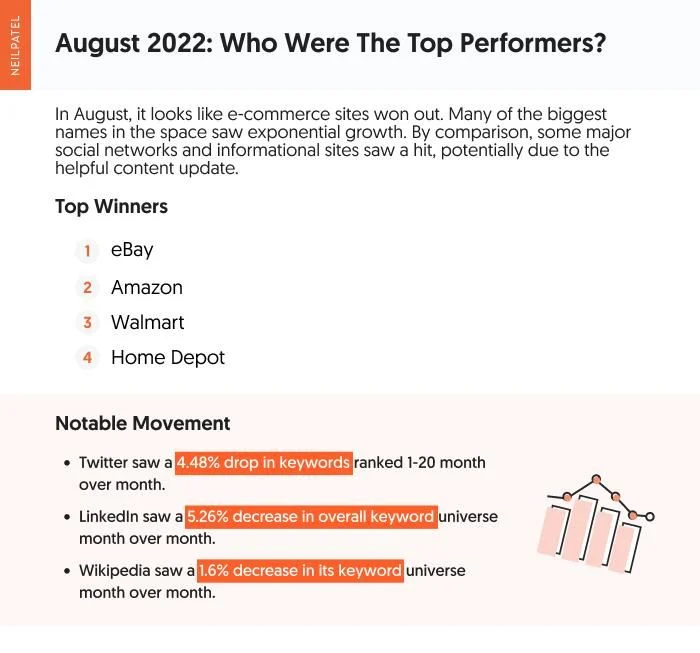
In August, sites such as eBay, Amazon, Walmart, and Home Depot emerged as the leading winners. It seems that Google prioritized e-commerce sites, as these platforms experienced significant keyword growth.
On the other hand, the losers in August included Google, Twitter, LinkedIn, and Wikipedia. These social networking and informational sites appeared to have suffered a decline.
Sites with extensive content that may not have been the most current possibly saw a drop due to Google’s Helpful Content Update (HCU), which was implemented in late August. Overall, Google experienced a 1.4% reduction in the keyword universe from July to August.
August Movement:
- Twitter's keyword count fell from 54,448,904 in July to 52,004,871 in August for positions 1-20.
- LinkedIn experienced a 5.26% decrease in its overall keyword universe.
- Wikipedia saw a 1.6% drop in its keyword universe month-over-month (MoM).
September:
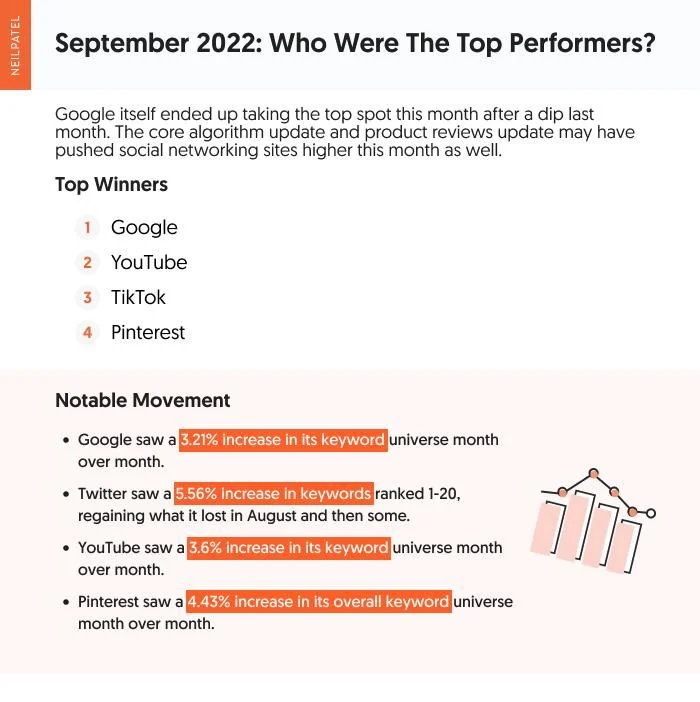
In September, Google made a comeback, securing the top spot as the leading performer. It was followed by social networking platforms such as YouTube, TikTok, and Pinterest.
The September core algorithm update and the product reviews update appear to have boosted social networking sites, pushing them to the forefront. Conversely, e-commerce sites fell out of the top positions.
These social networking platforms experienced significant growth in their keyword universes.
September Movement:
- Google saw a 3.21% increase in its keyword universe.
- Twitter recovered its keyword rankings for positions 1-20, with a 5.56% increase, reaching 54,899,877 keywords.
- YouTube experienced a 3.6% rise in its keyword universe.
- Pinterest saw a 4.43% increase in its overall keyword universe, and a 5% increase in its page 1 keywords.
The September losers were sites that appeared to be potentially spammy or unreliable. This suggests that Google may have been effective in filtering out low-quality sites, focusing instead on delivering helpful, accurate content from reputable sources.
October:
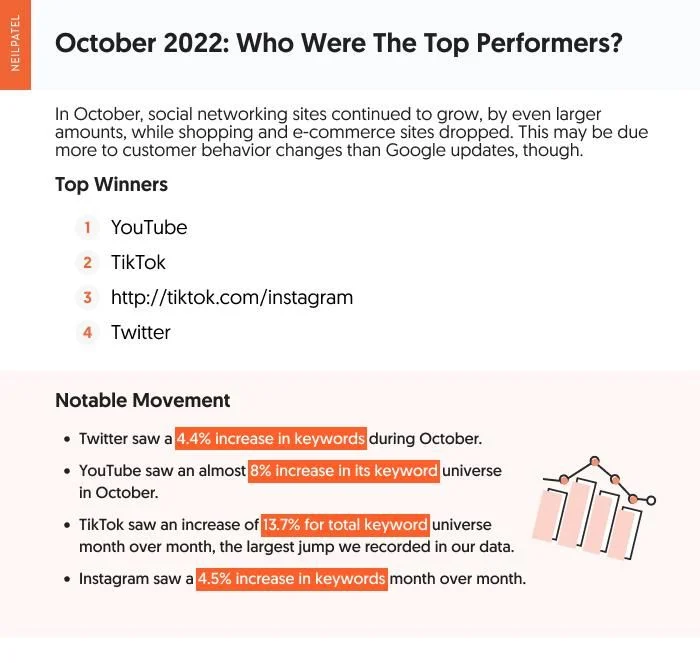
In October, social networking sites continued to lead in keyword growth and expansion. The top performers were YouTube, TikTok, Instagram, and Twitter.
October Movement:
- Twitter saw a 4.4% increase in its keyword universe, reaching a total of 57,272,225 keywords.
- YouTube experienced a nearly 8% rise in its keyword universe, with a total of 452,210,446 keywords.
- TikTok achieved a remarkable 13.7% increase in its keyword universe month-over-month (MoM).
- Instagram had a 4.5% MoM increase in its keyword universe.
In contrast, sites like Amazon, Walmart, eBay, and Google experienced notable declines in their keyword universes MoM. Specifically, Google lost 47.7 million keywords, Amazon lost 10.1 million, eBay saw a reduction of 8.3 million, and Walmart lost 6.7 million keywords.
After the updates in September and the impact of inflation, shopping and e-commerce sites faced significant keyword losses.
This shift is noteworthy, given the rapid growth of social e-commerce in recent years. The data suggests that Google is not only refining its own search results but also encouraging sites to improve their quality through these updates.
5 Tips for High-Quality Product Reviews
If the Google product review update seems daunting, don’t let it intimidate you.
There’s a positive aspect to this update.
Google has provided extensive guidelines to help you adjust your content strategy, ensuring your product reviews rank higher.
To assist you further, I’ve compiled five strategies for crafting high-quality product reviews. These tips will help your content rank well and attract organic traffic, enabling your audience to make better purchasing decisions while drawing in new readers.
Ready to enhance your product review strategy?
Here are the top tips and actionable steps to align your product reviews with Google’s product review update:
1. Include Product Visuals
Consider this: When purchasing a new product, would you rather read extensive descriptions or see the product in use?
Most people prefer seeing the product in action and viewing it from different angles. Studies reveal that visual content is processed more quickly and easily, as people typically read only 20% of the words on a page. For instance, on social media platforms like Facebook, posts with images receive 2.3 times more engagement than those without.
Google has recognized this trend and now favors product reviews that feature "evidence of products being tested."
Wondering what a visual product review looks like?
Check out an example from Tom’s Guide, a tech product review site, which showcases real visuals in their product reviews.

Honest feedback is crucial for guiding consumer choices, which is why Google is encouraging affiliate review sites and other product reviewers to provide genuine reviews supported by visual evidence of the product being tested.
This means your product reviews are more likely to rank higher if they include authentic images, videos, and other forms of evidence showing that you have actually used the product. Using stock photos may lead to penalties.
2. Offer Multiple Purchase Links
Isn’t it great to have options when shopping online?
If you find a product you like but prefer not to buy it from a single retailer, having multiple purchasing options can be very appealing. Online shopping becomes more convenient when you can choose from various sellers and product varieties.
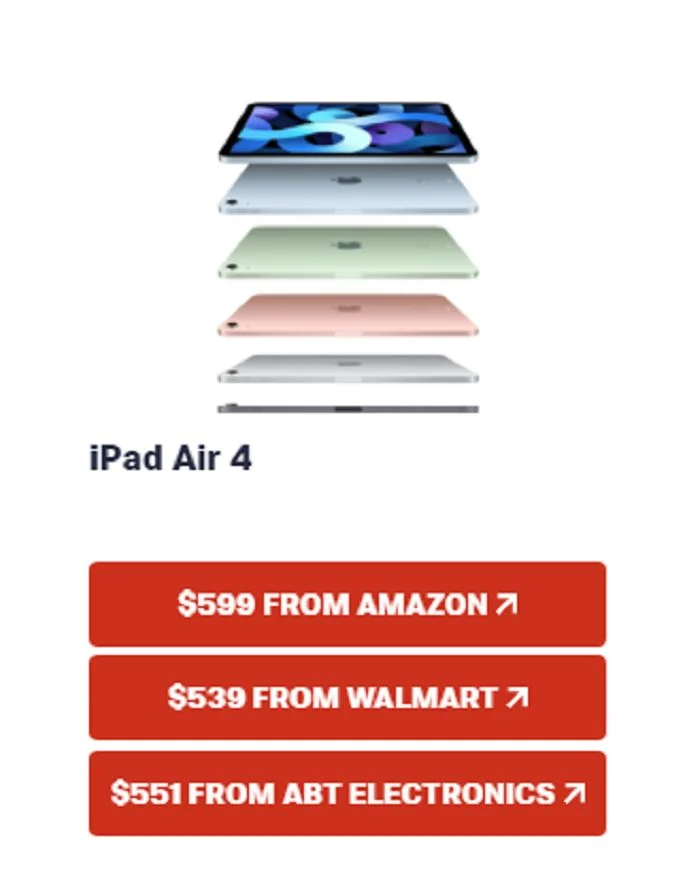
As a result, Google’s product review update now favors reviews that include “links to multiple sellers, giving readers the option to choose where to purchase.”
For example, if you’re writing an affiliate review for Samsung tablets, don’t just include a link to Amazon. Add links to the official Samsung site, BestBuy, eBay, and other retailers so that users have several options.
The best part? You don’t need to put in extra effort—just include multiple affiliate links on the same page, positioned together.
Check out this example from Digital Trends to see how multiple retailer links can be effectively incorporated into product reviews.
3. Write With the Reader in Mind
When shopping online and reading product reviews, what do you focus on?
You seek detailed information about the product and insights into how other users have experienced it. Key questions might include: Does the product break easily? Does its color fade over time? How well does it pair with other items?
Including this type of information in your reviews is essential for providing genuinely helpful, high-quality content. By addressing these details, you position yourself as a knowledgeable authority in your field, which can enhance reader loyalty and improve your conversion rates.
Ultimately, you’re not only aiding your readers in making informed purchasing decisions but also establishing yourself as a leader in your industry. It’s a beneficial outcome for both you and your audience.
4. Highlight How the Product Outperforms Competitors
Sometimes, a product review needs more than just a description. If you're deciding between products, such as choosing between a Samsung and an Apple tablet, you’ll look for reviews that compare the two.
This is where comparison reviews become invaluable. If your review explains how your product outperforms its competitors, you are more likely to help consumers make an informed decision.
Check out this example of a comparison review from the Chicago Tribune to see how contrasting products can be effectively showcased.
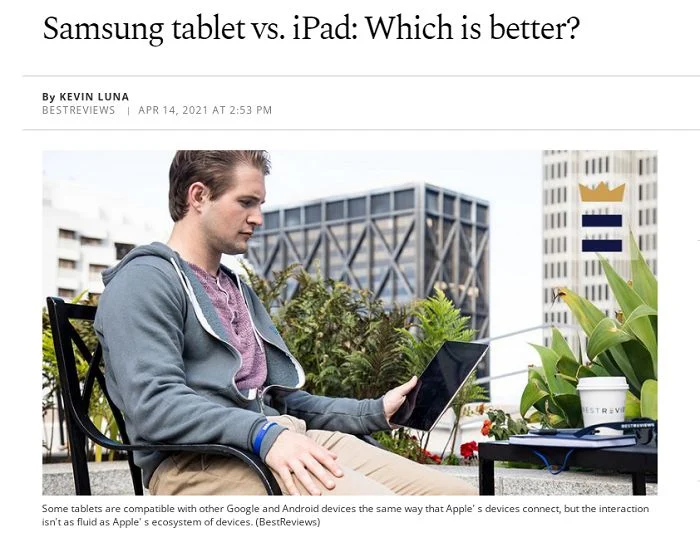
Google's new product review update now favors reviews that provide comparisons between competing products. To improve your ranking, focus on explaining how Product X compares to competitors, highlighting both its advantages and disadvantages.
5. Provide More Information Than the Manufacturer
Consumers often seek additional insights beyond what manufacturers provide. To make your reviews more valuable, offer unique details not found on manufacturer or retailer websites.
Some examples of useful details include:
- How does the product feel to the touch?
- What is the product's longevity?
- Where might the product break, tear, or fade?
- What challenges might users encounter?
- What unexpected benefits does the product offer?
Frequently Asked Questions
How do I get more reviews for my business?
Encourage customers to leave reviews by asking them directly. Make the review process easy on your product pages and follow up with reminders to submit a review.
Can I delete negative reviews?
While you can delete negative reviews, it’s better to address them with excellent customer service. Respond quickly to negative feedback, investigate the issue, and show your customers that you care about resolving the problem.
How many reviews do I need?
Having more reviews helps improve your Google rankings and makes it easier for potential clients to find you. Aim for an average rating between 4.2 and 4.5 stars.
How should I respond to a review?
Responding to reviews shows you value customer feedback. Whether you handle responses yourself or train your team, ensure you express appreciation for the feedback received.
How quickly do I need to respond to reviews?
Respond within seven days, as over 50% of consumers expect a reply within this timeframe.
Conclusion
Google continually updates its algorithm to enhance user search experiences. The latest product review update emphasizes the importance of detailed, helpful reviews.
Affiliate marketers and e-commerce businesses should adapt to these changes, focusing on crafting thorough, informative reviews that rank well and attract organic traffic.